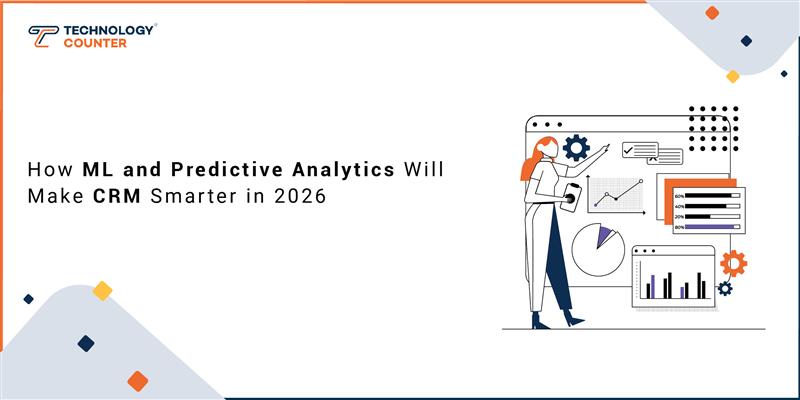
CRM software used to be the only way to keep track of contacts online. It can do a lot more now. They'll worry more about how well they use that data. These days, businesses want CRMs to do more than just keep track of conversations. They want children to be able to predict what will occur, assist others in making decisions, and to also do some things independently.
That transformation is possible because of machine learning and predictive analytics. These technologies transform raw client data into meaningful information that enables business firms to understand what clients want, prevent the alienation of a client from them, and make money. Below, find out how ML and predictive analytics are going to disrupt CRM systems in 2026. It also tells firms why they need predictive CRM right away.
Things You Should Know About Using Machine Learning and Predictive Analytics in CRM
What Does It Mean for CRM to Incorporate Machine Learning?
Using algorithms to look at customer data, uncover patterns, and make things better over time is what machine learning in CRM means.Some key qualities are:
-
Learning from how clients did in the past and how they are doing currently.
-
Seeing things that other people might not notice.
-
Improving at producing forecasts all the time without having to update the rules by hand.
-
Adapting to what people desire and what's going on in the globe.
When data changes, traditional rule-based automation doesn't, but ML-powered CRM solutions do.
What Form of Analytics Can Tell You What's Going to Happen?
Predictive analytics could generate smart guesses about what will happen in the future by looking at old data, statistical models, and machine learning algorithms. You can answer questions like these with CRM software that lets you do predictive analytics:
-
Which leads are most likely to buy something?
-
Who is most likely to discontinue being a customer?
-
What do you think we will do in the next three months?
-
What should the salesperson do next?
There will be more AI infrastructure, better data, and models that can work with data as it happens by 2026.
Why CRM Should Use Machine Learning and Predictive Analytics in 2026
There are several reasons why ML-powered CRM isn't just nice to have; it's something you need:
-
The volume of client data on all platforms is expanding.
-
These days, people want more options.
-
More people want to win and less time to buy
-
It's time to choose.
-
More pressure is to make money because marketing and sales costs are considerable.
These days, it's impossible to keep up with clients when you have to do everything by hand and use static dashboards.
How Ml Makes CRM Better: Smart Lead Scoring and Setting Priorities
It is against the law to score leads the old way. Machine learning-based lead scoring looks at:
ML Makes Predictions More Accurate By:
-
Seeing how sales have changed over the years
-
Seeing patterns in the seasons
-
Finding things that make deals less safe
-
Changing projections on the fly
Sales leaders may have a better notion of how much money they will make in the future and how strong their pipeline is.
Cleaning and Adding More Data by Itself
One of the hardest things about CRM is that the data isn't always correct. ML is useful because
-
Finding the same records.
-
Making things work that don't fit.
-
Putting information from other locations into profiles.
-
Making sure that databases are working and don't have any issues.
This makes sure that what you see and hear is authentic.
Using Contemporary Crm with Predictive Analytics to Figure Out Which Clients Might Leave
When something goes wrong, predictive CRM systems check for signs like:
Companies can prepare ahead of time by:
-
Starting to market to keep consumers
-
Giving them rewards that are special to them
-
Improving the experience for the client before they depart
Predictive Customer Lifetime Value (CLV)
Predictive analytics aims to forecast how much customers will be valued in the future by looking at these things:
-
How many times a week do you go shopping?
-
How much do people want to know?
-
Talk about asking for help.
-
The capacity to sell more than one item at once
This gives firms the ability to:
-
Invest your money in people who are worth a lot.
-
Make it easier to separate groupings.
-
You'll make more money in the long run.
Personalization at Every Stage of the Customer's Journey Based on Machine Learning
You don't have to use first names in emails anymore to make them look like they're from you. With CRM that employs ML, you can achieve these things:
-
Based on what we think will happen, here are some options for emails and content.
-
Changing how people act based on what they do
-
Personalization in real time at every point of contact
-
Customers' trips that change on their own
Customers are happier and more loyal when they have experiences that are important to them.
How Predictive Crm Helps Sales Teams and Other Groups That Need It
Sales Teams
People Who Work In Marketing
-
How much faith you have in a campaign's success
-
Take better care of leads
-
Modeling giving credit better
-
Better tracking of the return on investment
Groups That Assist People Get Things Done
-
Learning about possible problems before they get worse
-
Smart ticket routing
-
How to help before things go worse
-
More reasons why customers are happy
Dashboards for Crm Powered by AI in 2026
CRM dashboards are no longer fixed in stone. Here are some significant traits:
-
News that informs you what's going to happen right now
-
When you ask CRM inquiries, do them in a calm approach, like you're talking to someone.
-
Images of warnings and forecasts
-
Useful advice instead of just numbers
For more AI-driven business tools that help organizations make smarter, data-backed decisions, explore Artificial Intelligence Software.
Data That Makes People Think About Their Privacy and Values
Being more responsible requires being smarter. Here are some of the most essential things:
-
How to make sure that ML models are fair
-
Making ensuring that estimations are clear and easy to understand
-
Keeping client information safe
-
Following the standards that protect data all throughout the world
Many of these responsible AI and data governance practices are already being adopted across modern HR Software platforms to ensure fair, transparent, and compliant people's management.
Issues With ML-Driven CRM
You should realize that predictive CRM has some good and some bad things about it:
-
The information isn't really good.
-
Putting together disparate systems.
-
Learning about models.
-
People should trust what AI says.
-
Concerns regarding costs and the state of the infrastructure.
Similar data accuracy and integration challenges are also common in advanced Payroll Software, especially as organizations automate financial and compensation workflows.
Conclusion
In the end, improved customer relationship management plays a crucial role in increased growth. The year 2026 will witness the initiation of the transition of customer relationship management (CRM) solutions from a passive to an active growth engine because of the usage of predictive analytics and machine learning.
Those businesses that adopt predictive customer relationship management know how to cultivate a better understanding of their clientele and extract further data from them, thereby making well-informed decisions. Predictive CRM is something that is now less coveted but rather has become a necessity due to the continuously rising demands of the customers.

 15 Jan 2026
 Reading Time : 6 Minutes








Post your comment