Why Measuring Trust Is Harder Than Tracking Traffic

 5 Nov 2025
 Reading Time : 4 Minutes
While traffic can be easily tracked, trust is more elusive and difficult to measure. This article explores why trust matters more for brand success, how it impacts customer loyalty, and the challenges in quantifying it. It also discusses strategies to nurture trust alongside traffic for long-term growth.
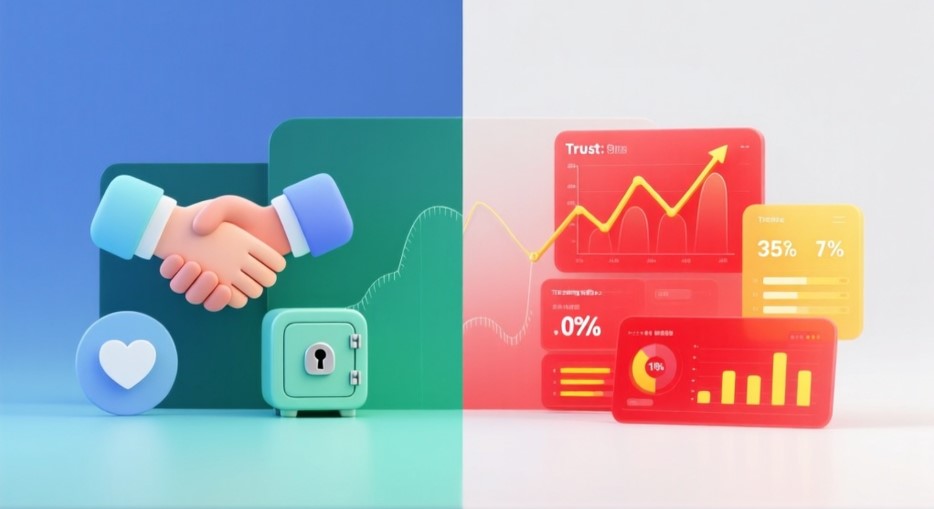
Traffic feels tangible. Tools like Google Analytics turn clicks into victories — easy to track, easy to celebrate. But trust—the invisible current beneath loyalty and conversion—resists such precision. You can see traffic spikes in a dashboard; you can’t chart the quiet conviction that makes people return.
The Ease of Counting Clicks
Traffic tells a clear story: how many people visit, how long they stay, and whether they convert. Analytics platforms have refined this into science — 2.3 pages per session, 40% bounce rate, and a 2-minute average visit.
It’s comforting data. Each upward line feels like proof of growth. Yet what these numbers really measure is motion, not meaning. A visitor can click without caring, linger without believing, buy once without trusting.
But what these numbers really measure is motion, not meaning. Learn more about the role of website traffic monitoring tools in digital marketing success.
A visitor can click without caring, linger without believing, and buy once without trusting. The data may tell you what happened, but not why. It’s the difference between tracking footsteps and understanding intentions.
Traffic answers what happened. Trust asks why.
The Elusiveness of Trust
Trust doesn’t show up in heatmaps or dashboards. It lives in perception — an unspoken calculus of safety, transparency, and credibility. The 2023 Edelman Trust Barometer found that fewer than 60% of people trust the information they encounter online, and those numbers drop sharply after data breaches or scandals.
In digital environments, trust is built through signals that algorithms can’t easily quantify:
-
Reliability: Sites that load consistently and protect user data.
-
Authenticity: Clear authorship, verifiable expertise, and honest communication.
-
Transparency: Straightforward privacy policies and visible accountability.
Even subtle design and language cues shape these perceptions. A missing SSL certificate, vague return policy, or aggressive pop-up can instantly erode credibility. Conversely, a simple “verified review” badge or genuine testimonial can rebuild it.
According to Forrester, 70% of abandoned shopping carts stem from hesitation, not price. That hesitation often reflects uncertainty — a lack of trust rather than lack of interest.
Why Measuring Trust Is So Difficult
Trust operates on emotion, not formula. It’s fluid across cultures, shaped by expectation, memory, and bias. In some regions, data protection builds trust; in others, social validation matters more. Algorithms can detect dwell time, but they can’t measure sincerity.
Companies try to approximate it with proxy metrics — repeat visits, retention rates, Net Promoter Scores. These indicators help, but they’re indirect. A 2023 Marketing Week survey found that only 40% of marketers feel confident in their ability to quantify trust.
Because trust builds slowly and collapses fast, data rarely captures its real fragility. A single breach, tone-deaf ad, or hidden fee can undo years of credibility — and no dashboard will warn you before it happens.
The Traffic vs. Trust Divide
Traffic can be bought, boosted, or gamed. Trust must be earned, nurtured, and proven.
A viral post can bring 50,000 visitors overnight. But if those visitors find inconsistency, misleading claims, or poor transparency, they’ll vanish just as quickly.
Analytics reward immediacy — spikes, sessions, and shares.
Trust rewards patience — reliability over time, responsiveness in crisis, and honesty when mistakes happen.
Consider Equifax: during its 2017 data breach coverage, the company saw millions of site visits. Yet, it lost over 40% of public trust. The numbers went up. The value went down.
The takeaway? Traffic reflects awareness. Trust reflects alignment. One can exist without the other, but real brand equity only happens when both grow together.
The Business Cost of Ignoring Trust
When trust becomes an afterthought, short-term traffic wins can erode long-term value. Bain & Company’s research shows that companies prioritizing trust alongside marketing grow lifetime customer value by up to 95%.
For brands, that means:
-
Integrating trust into analytics: Pair traditional KPIs like sessions or CTRs with qualitative indicators — sentiment analysis, review scores, referral consistency, and earned mentions. Monitor what people say after they interact, not just during.
-
Embedding transparency: Be explicit about data usage, communicate openly during crises, and show your human side in interactions. Brands that own their mistakes publicly often gain more respect than those that hide them.
-
Aligning UX and credibility: Good design equals perceived reliability. HTTPS, privacy badges, consistent layouts, and real author bios all reinforce professionalism. Even subtle design cues — readable typography, predictable navigation, or secure payment icons — build subconscious confidence.
Brands like Patagonia and Salesforce prove that visibility and integrity can scale together. Their success isn’t built on traffic alone — it’s built on the credibility that keeps people coming back.
For organizations managing sensitive information or facing negative search results, reputation management becomes essential to building digital trust.
Companies like NetReputation help bridge this gap by auditing what audiences actually see online — from Google results to AI-generated summaries. Their approach reinforces what analytics can’t measure.
By helping brands control misinformation, highlight credibility signals, and optimize their online presence, NetReputation ensures that visibility aligns with trustworthiness — the combination every sustainable brand needs.
Rethinking What Success Looks Like
Traffic is a reflection of reach. Trust is a reflection of character. Both matter — but only one sustains the other.
The future of analytics won’t belong to those who count the most visitors. It will belong to those who earn the most confidence — the brands whose data dashboards may never show the full story, but whose audiences already know the truth.




Subscribe & get all related Blog notification.




Post your comment