How Enterprise Maintenance Scheduling Drives Digital Transformation in Manufacturing

 10 Jul 2026
 Reading Time : 6 Minutes
This article explains how enterprise maintenance scheduling plays a vital role in accelerating digital transformation in manufacturing. It highlights the benefits of centralized work order management, predictive maintenance, real-time visibility, workforce optimization, and compliance tracking. The article also explores how modern CMMS platforms support advanced scheduling, discusses common implementation challenges, and provides a practical roadmap for improving maintenance operations, reducing downtime, and increasing operational efficiency.
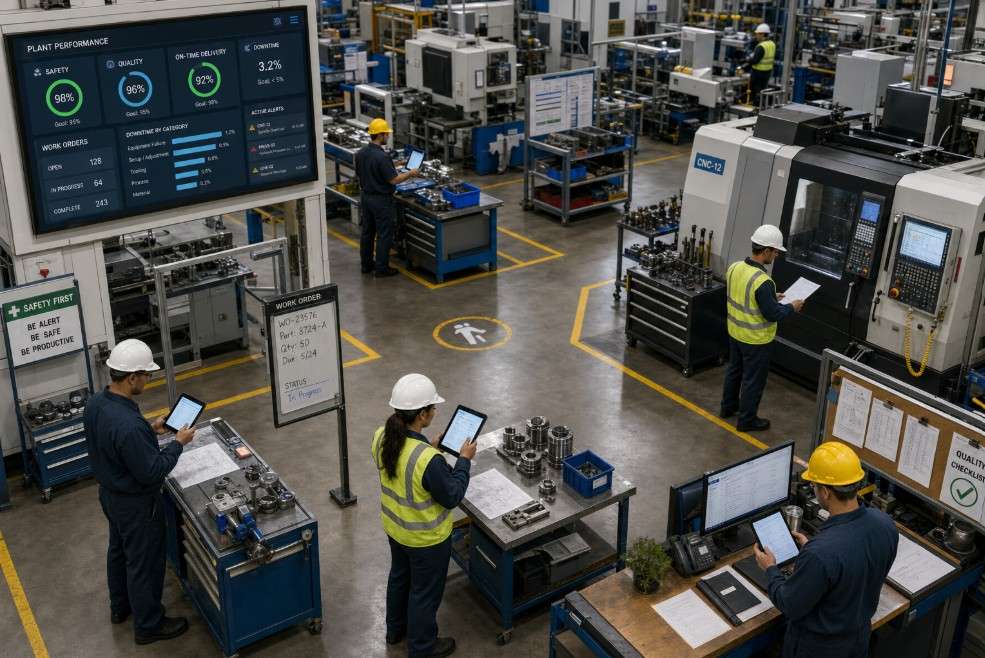
Why Maintenance Scheduling Is a Digital Transformation Priority
Most manufacturers pour significant resources into digitizing production lines, supply chains, and analytics platforms. But maintenance scheduling, the backbone of asset reliability, is frequently left running on spreadsheets and tribal knowledge long after everything else has gone digital. It is a costly blind spot. According to Siemens, unplanned downtime costs industrial manufacturers billions each year, with estimates reaching $50 billion annually across the sector. Few transformation levers deliver faster payback than fixing how you plan and dispatch maintenance work.
Enterprise maintenance scheduling, in this context, refers to the systematic, technology-driven planning and dispatching of work orders across plants, assets, and teams. It is typically orchestrated through or alongside a CMMS (Computerized Maintenance Management System) and replaces ad hoc coordination with structured, data-informed workflows.
Key Ways Maintenance Scheduling Accelerates Digital Transformation
Here are five concrete ways that upgrading your maintenance scheduling capability moves the digital transformation needle:
1. Centralized Work Order Management
Consolidating scheduling across platforms like SAP PM, IBM Maximo, and JD Edwards eliminates the data silos that plague multi-plant operations. Instead of planners maintaining separate spreadsheets per facility, a unified scheduling layer creates a single source of truth for every open, pending, and completed work order.
2. Predictive and Condition-Based Scheduling
When scheduling tools ingest IoT sensor data, maintenance shifts from calendar-based routines to condition-based triggers. A vibration spike on a critical pump can automatically generate and prioritize a work order before the asset fails. This is predictive maintenance powered by IoT and analytics in practice, and it represents one of the highest-value capabilities in any Industry 4.0 roadmap.
3. Real-Time Visibility and Reporting
Digital scheduling dashboards give plant managers live insight into backlog depth, technician utilization rates, and asset health trends. No more waiting for a Monday morning report to discover that weekend work orders slipped.
4. Workforce Optimization
Intelligent scheduling matches the right technician to the right work order based on skills, certifications, and proximity. The result: reduced idle time, fewer return visits, and improved first-time fix rates. For organizations running lean maintenance crews across multiple sites, this optimization is not a nice-to-have.
5. Compliance and Audit Readiness
Automated scheduling creates a digital trail of completed inspections, regulatory tasks, and preventive maintenance activities. In regulated industries like food and beverage, pharmaceuticals, or energy, that trail simplifies audits dramatically. You spend less time assembling evidence and more time running operations.
How Modern CMMS Platforms Support Smarter Scheduling
Most manufacturers already run a CMMS. SAP PM, IBM Maximo, and JD Edwards are deeply embedded in thousands of plants worldwide. The challenge is that native scheduling capabilities in these platforms tend to be limited or rigid. They handle work order creation and tracking well, but advanced scheduling features like drag-and-drop Gantt views, constraint-based planning, and dynamic rescheduling are often missing or require heavy customization.
This is where bolt-on scheduling tools come in. These specialized modules layer on top of an existing CMMS to fill functional gaps without replacing the core system, adding visual scheduling, enhanced reporting, and flexible dispatching while preserving existing ERP investments. Vendors such as Sockeye work in this category. For companies that cannot justify a full platform migration, and that includes most mid-to-large manufacturers, extending the current system is a pragmatic path forward.
One critical integration consideration: bi-directional data sync between the scheduling layer and the CMMS must be airtight. Work order status, labor hours, and material usage need to stay accurate across both systems in real time. Without that sync, you risk creating a new data silo instead of eliminating one.
Common Challenges and How to Overcome Them
Modernizing maintenance scheduling is not without friction. Here are the obstacles that trip up most organizations, along with practical ways to get past them:
Resistance to Change
Maintenance teams that have relied on paper-based systems or personal spreadsheets for years will push back on new tools. The solution is to involve technicians and planners early in the selection process, demonstrate concrete time savings during training, and run a pilot on a single asset group before scaling.
Data Quality Issues
Legacy CMMS data is often incomplete. Missing asset records, outdated bills of materials, and inconsistent naming conventions will undermine any construction scheduling tool you deploy. Before go-live, conduct a focused data cleanup sprint. Prioritize critical assets first and expand from there.
Perfect data across every asset is not realistic on day one, but accurate data on your top 20% of failure-prone equipment is achievable and impactful.
Integration Complexity
Connecting a scheduling tool with SAP, Maximo, or JDE can be technically demanding, especially in environments with heavy customization. Choose solutions that offer pre-built connectors and APIs designed for major CMMS platforms. This cuts implementation timelines significantly and reduces the burden on your IT team.
Measuring ROI
Leadership often struggles to quantify the value of scheduling improvements. The fix: define your KPIs upfront and track them rigorously. Key maintenance performance indicators like schedule compliance, wrench time, mean time to repair (MTTR), and the ratio of planned to unplanned maintenance all provide concrete evidence of progress.
Building a Roadmap for Maintenance-Led Digital Transformation
Ready to move from theory to action? Here is a five-step roadmap you can adapt to your organization:
-
Step 1: Audit your current state. Assess existing CMMS usage, scheduling maturity, and data quality across your plants. Identify where planners spend the most time on manual coordination and where breakdowns occur most frequently.
-
Step 2: Define scheduling KPIs and targets. Align them with broader operational goals. A target like "reduce unplanned downtime by 20% within 12 months" gives the project a clear success metric that leadership can rally behind.
-
Step 3: Evaluate bolt-on vs. replace options. Determine whether your existing CMMS can be extended with a scheduling layer or whether a platform change is warranted. For most organizations, extending the current system is faster and less disruptive.
-
Step 4: Pilot, measure, and scale. Start with one facility or one asset class. Prove value with hard numbers, then expand to additional sites. Pilots build internal champions, and champions drive adoption.
-
Step 5: Connect scheduling data to enterprise analytics. Feed maintenance insights into plant-wide dashboards and business intelligence tools. When scheduling data informs capital planning and operational strategy, maintenance stops being a cost center and starts being a strategic function.
Manufacturers that treat maintenance scheduling as a strategic digital capability, not just a back-office task, will be far better positioned for Industry 4.0 maturity.
Final Thoughts
Enterprise maintenance scheduling is a high-impact, frequently underestimated driver of digital transformation in manufacturing. Whether you run SAP, Maximo, JDE, or another CMMS, improving how you plan and schedule work orders delivers measurable gains in uptime, efficiency, and regulatory compliance.
The starting point is honest: assess your current scheduling maturity, identify the gaps, and explore tools that integrate with the systems you already have. Small, well-measured improvements compound quickly, and the operational benefits extend well beyond the maintenance department itself.




Subscribe & get all related Blog notification.




Post your comment