How Video Calls Are Helping People Talk Across Languages

 24 Nov 2026
 Reading Time : 5 Minutes
This article explores how video calls are making professional interpreting more accessible across healthcare, education, government, community services, and business environments. It explains the benefits of remote interpreting, including faster access to qualified interpreters, visual communication, and reduced travel requirements, while acknowledging challenges such as technical issues and limited nonverbal cues. It also shares practical tips for successful interpreting sessions and key questions to ask when choosing a video interpreting service.
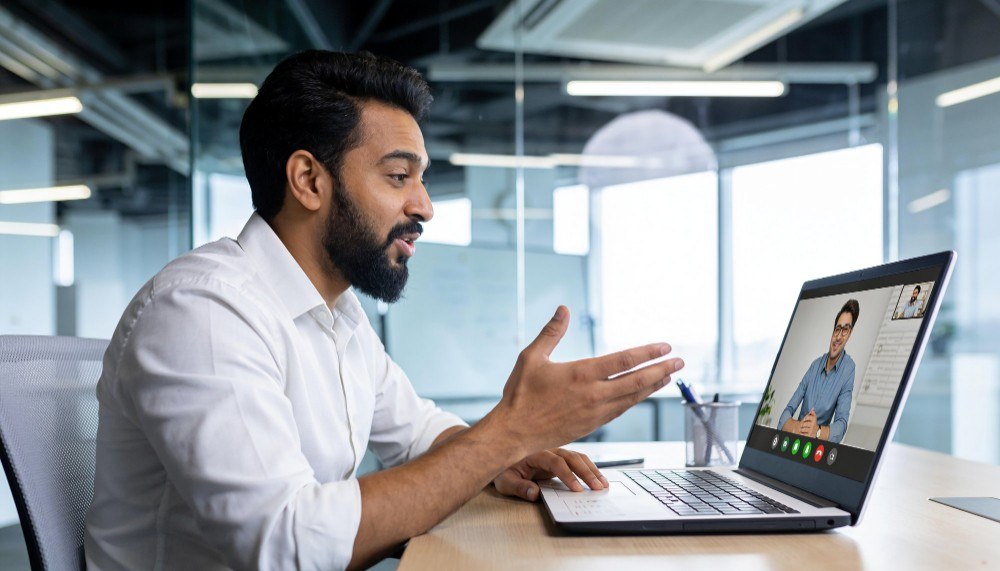
Ten or fifteen years ago getting an interpreter was one of two things: Someone drove across town to sit in the room or you called a phone line and hoped whoever answered could hear you. Now it’s often just a laptop and decent wifi connection. That seems like a small change but it is. Hospitals, schools, government offices and most businesses now do language barriers differently and people who used to go without help don’t have to anymore.
Why language access matters
A patient can’t find the words for pain. A mother looks at a letter from her son’s school and doesn’t know if it’s a permission slip or a warning. Neither scene is dramatic but they are stressful and they happen every day.
Usually somebody grabs whoever speaks both languages: a friend, coworker, sometimes the person’s kid. It works up to a point. Details get dropped and honestly it’s too much for a ten year old to wear.
A trained interpreter does most of that. They get the meaning right (and don’t take sides). The hard part has always been finding one. Plenty of small towns have no qualified interpreters at all (for some languages there may be only a handful in an entire region). Video fills the gap.
So why video?
Because people don’t communicate with words alone. A frown, a shrug, the way someone leans back when they aren’t sure all of that has meaning and on a phone call it gets thrown away; on video call the interpreter sees the confused look, pauses and says it another way.
Then there’s logistics. An interpreter could be three cities away or in another country but can join within minutes (no travel required). When it’s urgent, or language is rare where you live, that matters a lot. It also means an organization doesn’t have to keep someone on staff for every language it might need.
Where you'll actually see it
Healthcare. Patients and clinicians have to understand each other or nothing works (trust included). If no bilingual staff member is available a hospital can bring an interpreter in by video for an urgent visit, a follow-up or one of those little “wait, when do I take this?” questions.
Schools use it too for parent-teacher meetings, enrollment and conversations about how a child is doing. Parents who aren’t fluent can participate instead of nodding along and hoping for the best.
Community groups, government offices and legal teams hold interviews and information appointments remotely when no one qualified is nearby. Businesses use it for international meetings; onboarding teams that don’t speak the same language; customer support. It costs far less than flying someone in.
It's not perfect
Of course not. A screen is not the same as being in the room. In 2024 researchers at University of Surrey published a survey of 47 professional interpreters working remotely in healthcare. Interpreters often said nonverbal and emotional communication didn’t come through as well face to face; video was an acceptable alternative but not full equivalence.
Still, the problems are manageable. A 2025 study in Frontiers in Public Health surveyed 87 interpreters in Austria and Germany and found video interpreting to be an efficient alternative to in-person work (challenges can be reduced by training healthcare staff to use it as well as improving conditions of sessions). But for sensitive or complex cases an interpreter in the room may still be better.
How a video interpreting session usually goes
Someone requests an interpreter for a language (either right away or booked for later) the interpreter comes in, introduces herself/himself and says what she/he does and makes sure everyone can see and hear properly. We go in short sections with the interpreter passing each one along faithfully without letting her/his own opinions interfere; at the end they check nobody needs anything repeated and that’s it.
One thing people don’t always know is that you speak to each other, not to the interpreter. Look who you are talking to. The interpreter is there to let you talk but not join in with what they are saying.
A few things that help
Test your audio before the call. Bad sound causes more confusion than anything else. Get a quiet place with good lighting and camera eye level; short sentences work better than long (idioms like ballpark figure or under the weather don’t usually make it); send medical/legal terms ahead of time to interpreter so they can prepare; pause every few seconds so they can keep up; plan B (dial in number if video drops).
If you're choosing a video interpreting service
If you hire a language translation solutions provider ask the hard questions first: What languages do they cover and how long does it take someone to join? If so, are there interpreters trained in your field (healthcare, education etc)? After the conversation what happens and how do they handle sensitive information? Will it work on phones/laptops staff/clients already have? If halfway through a session it fails, is there a real person you can call? The answers matter as much as the technology does.
Where this is going
Video gets sharper, more secure and easier to use and language support keeps getting better too. It’s not just a big hospital anymore. A small school can get an interpreter on screen in minutes; a neighborhood clinic or community group? Sure thing. The goal hasn’t changed though: everyone in the conversation should be heard and understood (in whatever language they speak).




Subscribe & get all related Blog notification.
Post your comment